
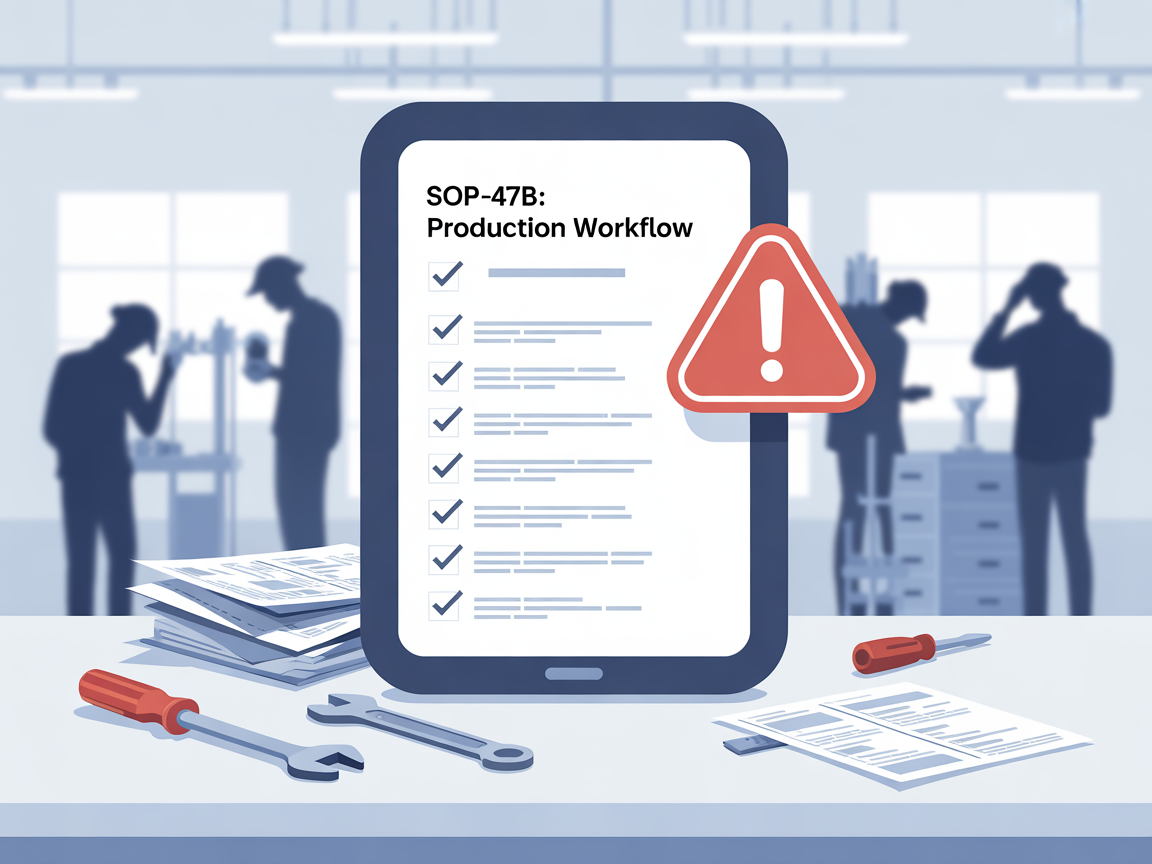
Why Your MSME System Fails — Even With SOPs, ISO, and ERP
The problem is not that you don’t have a system.
The problem is that you think you do.
🎥 Prefer listening? Watch the Tamil version of this post here:
1. “We Have a System” The Four Words That Hide a Lot of Firefighting
You have said this before. Or someone in your business has said it.
“We already have systems.”
“We wrote everything down.”
“We got ISO certification.”
“We use software for everything.”
And yes this is true on the surface.
You do have documents.
You do have software.
You did train people.
You spent time, energy, and money making everything “ready.”
But here’s what’s strange. Even after all that work, something still feels wrong.
You still chase late orders.
Customers still call with complaints.
You still feel like the system should work… but it doesn’t.
This is the part no one tells you about.
Having a system is not the same as using one.
What you have might look complete. But if people don’t follow it, if it doesn’t solve daily problems, if it stays quiet when things break then it’s just papers on the wall.
This blog explains that gap.
Not to scare you. Not to blame you. But to help you see why even well-written systems fail and what you can do about it.
2. The Documentation Trap
We started treating system-building like a to-do list.
Write down the steps. Make flowcharts. Get a consultant. Get certified. Buy software. Create user accounts. Done.
The more papers you have, the more “systematic” it feels.
But there’s a big gap no one talks about: A written process is not the same as a working system.
The papers might say, “check every batch.” But what does “check” mean on the factory floor? Look at it? Measure it? Who decides if it passes? Where do you write the results? Does anyone care if that step gets skipped?
What you write doesn’t matter if it doesn’t guide actions when no boss is watching.
This is the difference. A real system makes people do the right thing by design, not by watching them.
It’s like printing a gym routine and putting it on the wall — then wondering why no one gets fit.
Just because you wrote it down doesn’t mean it works.
Just because it’s written, doesn’t mean it’s working.
3. Why Systems Die (Even When You Write Everything Down)
Here’s where things fall apart. Not loudly but slowly.
Most small businesses don’t crash because of one big problem. The real damage happens quietly every day. In the gaps between what you plan and what actually happens.
Let’s talk about those gaps.
1. No Shared Purpose
When your team follows a system just to “pass the audit,” you already have trouble.
Because purpose drives attention. And without attention, nothing gets better.
If the only reason a process exists is to check a box, then the first time pressure comes — the system gets thrown away.
A working system doesn’t just list steps. It connects those steps to a real reason people can feel.
2. No Ownership
People rarely care about what they didn’t help build.
If your team didn’t help shape the system, they won’t step in to fix it when it breaks. Over time, the system becomes a post on the wall there, but ignored.
Ownership isn’t given. It grows through involvement, not instruction.
3. No Visibility
Ask yourself can your system raise its hand when something breaks?
If problems only show up during reviews, reports, or escalations that’s not a system. That’s a silence machine.
Visibility means people see what’s happening. Not through spreadsheets. But through simple signs.
On the wall. On the board. In plain sight.
A living system shows its heartbeat.
4. No Feedback Loops
Even a great process will break. That’s not failure that’s reality.
But what happens after it breaks tells you if the system is alive.
Does it adjust? Does it evolve? Do people report problems or quietly patch and move on?
No loop = no learning.
5. No Adaptability
If your system hasn’t changed in the last 12 months despite team changes, process shifts, or growth, then it’s not adapting.
And what doesn’t adapt… eventually cracks.
4. Dead Systems vs Living Systems
You might be wondering — How do I know which side I’m on?
Here’s the breakdown:
| Category | Diagnostic Question | Dead System | Living System |
| Purpose | – Why does this system exist? – What problem does it solve daily? | – We made it for ISO. – Customer asked for it. – Boss said we need it. | – It helps us reduce customer complaints. – It prevents rework. |
| Ownership | – Who improves this system when problems arise? – Who cares if it breaks? | – Only I review it. – The consultant built it, I maintain it. | – My team updates it based on real issues. – Operators suggest improvements. |
| Visibility | – How quickly do you know when something goes wrong? – Can anyone see the system’s health right now? | – We check data at the end of the week. – Monthly reports tell us what happened. | – We see issues the moment they happen. – Dashboard shows real-time status. |
| Feedback | – What happens when someone spots a problem?- Do insights from the floor reach the system? | – Nobody talks unless there’s a mistake. – We only hear about big failures. | – Even small issues are discussed and recorded. – Ideas flow upward. |
| Adaptability | – When did this system last change?- How does it respond to growth or new challenges? | – We haven’t changed it in years. – If it’s not broken, don’t fix it. | – It evolves as we grow. – We improve it before problems force us to. |
If you saw yourself more on the left side you’re not alone.
SCORING: Count how many answers fall in the “Dead System” column.
0-1: Your system is breathing well
2-3: Warning signs – needs attention
4-5: Life support needed – time for revival
The good news? You can fix all of these.
5. Why We Keep Building Dead Systems — Without Realizing It
Nobody wakes up and says, “Today I’m going to build a lifeless system that people will ignore.”
So how does it keep happening?
It’s not because you don’t care.
It’s not because your team is lazy.
And it’s definitely not because you’re not trying hard enough.
It’s because of a few quiet beliefs we all carry. Beliefs that feel logical… but quietly break everything.
Let me show you three of them.
Belief #1: If it’s clearly written, they’ll follow it.
You sit down. You map the steps. You write each instruction as clearly as possible. In your mind, this is it. Simple. Perfect. Done.
But then on the floor people skip steps.
They do things their way.
Or worse… they avoid using it altogether.
Why?
Because clarity on paper is not the same as clarity in real work.
People don’t follow what’s printed. They follow what feels useful. What fits their pressure. What makes sense when they’re tired, stressed, and trying to hit today’s target.
Belief #2: Once built, it will run.
I’ve been here. Maybe you have too.
You finally create the system. You launch it. You explain it. You even get some early results. And then… you move on.
Until one day, it breaks. Not because someone messed up but because the world changed while the system didn’t.
A supplier changed.
A new customer came in.
You grew from 10 to 25 people.
But the system stayed the same and slowly, what once worked stops working.
Not because it was wrong. But because it was frozen.
Belief #3: More detail means better control.
This one hurts, because it feels so smart.
We think: “If we just add one more column, one more signature, one more checklist people will make fewer mistakes.”
But instead of control, we create mess.
People stop reading.
They start skipping.
They forget which version is the latest.
And they do what humans always do under overload they guess.
The truth? Simple systems get followed. Messy systems get avoided.
So what’s the fix?
Not new software.
Not more forms.
Not a bigger flowchart.
The real fix is this:
Start seeing your system the way your people see it.
Not as the designer but as the person using it at 4:45pm, with three calls waiting and one shift left to finish.
Because the moment your mental model shifts…That’s when your system starts breathing again.
6. So What Actually Works?
This is where most people make things too complex. They think systems need dashboards, signatures, and ten-step flows.
But what small businesses really need is simpler and harder: A system that people can use, improve, and trust.
Here’s how that starts:
1. Start with purpose. Don’t create systems for ISO. Create them for problems. What are you trying to solve? Late delivery? Missed checks? Training gaps?
When the system solves your problem not the auditor’s, people will start using it without being told.
2. Build ownership. If your people weren’t part of building it, they won’t fix it when it fails. Even small involvement leads to big protection.
3. Make the work visible. If you can’t see what’s working or breaking at a glance, people will guess. You don’t need software. Sometimes, a simple whiteboard speaks louder than a report.
4. Ask for feedback. Ask: “What’s not working?” regularly. Not just during audits. During the work. That one habit can keep your system alive and growing.
5. Let it grow. Your system should grow as your team grows. Not big changes. Just steady tweaks before problems force your hand.
That’s it.
No buzzwords. No complexity.
Just real systems, built with your people — and built to last.
7. The Wake-Up Call
Three questions that can change how you see your system:
- When did you last improve your system not for audit, but for actual improvement?
- Do people rely on the system or bypass it to get things done?
- Is your system helping you grow or just helping you survive?
If those hit hard, don’t worry. That’s the point.
Now you can finally see what needs fixing and what doesn’t.
8. What Next? A 30-Minute Reality Check
If this sounds familiar — let’s talk.
No pitch. No pressure. Just a 30-minute clarity session where we walk through your system, piece by piece.
You’ll leave with a mirror not a report.
If you’ve got a system that’s stopped working, stuck, or quietly failing… we’ll figure out where to start bringing it back to life.
Book a Clarity 30 Call.
Let’s make your system breathe again.