
How to Build a System Your Team Actually Uses — A Practical Guide for MSMEs
Imagine this.
You take a two-day holiday.
No urgent calls. No last-minute crises. No “Sir, what do we do now?” messages on WhatsApp.
Work keeps flowing. Deliveries go out. Quality checks happen. Decisions get made without you.
That’s not luck. That’s a system.
And it’s exactly what you can build — even if your factory feels like it’s running on memory, shortcuts, and daily firefighting right now.
Over the last few weeks, we’ve seen why systems fail, the myths that kill them before they start, and how even documented ISO systems often collapse on the shopfloor. Now it’s time for the practical part — how to actually create a working system that lives and breathes inside your business.
🎥 Prefer listening? Watch the Tamil version of this post here:
Why Most Systems Never Work
Before we jump into the “how,” we need to understand why most systems die.
You know that feeling when you implement something to improve your business, but three months later, everything goes back to the old way? That happens because most people focus on fixing one thing without thinking about how it affects everything else.
Everything in this world is connected in some way. As above, so below, so below as above. This is the fundamental principle of everything from the Kybalion.
When businesses try to implement improvements, they always focus on one thing. What they miss is the impact on other parts of the business. They forget to think about the whole system.
You might have experienced this when you give your vehicle to a mechanic for service. Even though he is experienced, without a proper system, he will start changing parts based on his experience alone. No troubleshooting steps. He might fix one problem but create three new ones.
What if he had a system for troubleshooting? He would follow steps, find the real cause, and change only what needs changing.
This is what most businesses do. They focus on tactical short-term actions without thinking about long-term impacts. They miss how everything connects.
Start Small, But Think About Everything
When owners hear “build a system,” they think of the entire business. Every process, every department, every form.
That’s a mistake.
You don’t build Rome in a day, and you don’t build a factory-wide system in one go. Instead, start with one recurring, costly problem.
Why? Because small, visible wins build momentum.
But here’s the key — you’re not fixing that one process alone. You’re fixing it while understanding how it connects to everything else in your factory. This keeps you out of the “fix one thing, break three things” trap.
It could be:
- Dispatch delays when a key person is absent
- Rework piling up on certain products
- Stockouts of common raw materials
- Customer complaints about the same issue, again and again
The smaller and more specific your starting point, the faster you’ll see results. And those results convince both you and your team that “this systems thing” is worth the effort.
Watch What Actually Happens, Not What’s Written
Here’s where many businesses go wrong.
They pull out the existing SOP or ISO procedure and say, “Here’s how it works.”
Except it doesn’t. Not in real life.
So skip the paperwork for a moment. Go to the floor. Watch the process in action.
Ask:
- Who’s involved from start to finish?
- What happens first, then next, then last?
- Where do things slow down or get stuck?
- Who makes decisions when something unexpected happens?
This is reality mapping. If the written process says “inspect every batch” but on the floor it’s “inspect when there’s time,” then your starting point is what’s really happening — not what’s printed on a laminated sheet.
Build It Together
This step transforms systems from “paper rules” into “our way of working.”
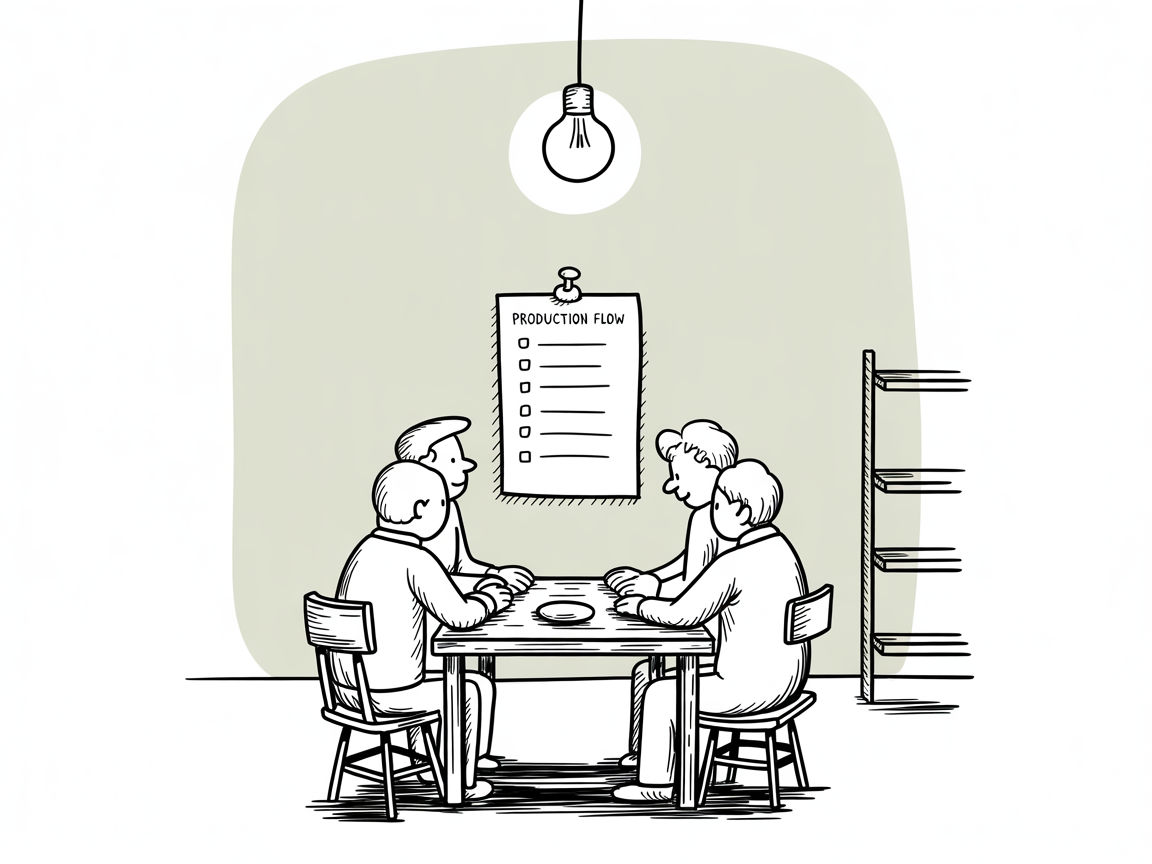
Sit with the people who actually do the work. Ask them: “What would make this faster, clearer, and less error-prone for you?”
You’ll be surprised at how much they already know — and how willing they are to improve things when you ask for their input instead of handing them a “finished system” from the office.
When people help build the system, they protect it. When you build it alone and hand it over, they ignore it.
The goal here isn’t perfection. It’s the simplest set of steps that works for your business right now. Sometimes it’s removing a step, sometimes it’s adding a small checklist, sometimes it’s changing who does what.
Make It Visible Where Work Happens
This is where most systems die — they live in files, not in the workspace.
If your new process is only in a word file or PDF, people will go back to using memory. And memory fails under pressure, especially during busy production days.
So make the system visible where the work happens.
In dispatch? A step-by-step flow pinned above the table. In quality check? A photo guide next to the inspection station. In stores? Reorder levels marked right on the rack.
The easier you make it to follow the system, the more people will use it. If they have to dig into folders, log into software, or remember where they saved the file — it’s already too late.
Test, Learn, and Keep Improving
Your first version is a prototype, not the final system.
Run it for one or two weeks. Then bring people together and ask:
- What worked well?
- What still caused confusion?
- Where did we still see delays or mistakes?
Make small changes. Keep testing until the process runs smoothly without constant reminders.
Here’s the important part: even after it’s working, revisit it every few months. A living system grows as your factory grows. A frozen system eventually breaks.
How This Works in Real Life
Let’s say you have a quality control problem. You have one person who knows exactly how to inspect every product. He knows which defects matter, which ones customers accept, and how to handle borderline cases.
When he’s absent, chaos. Products pile up waiting for inspection. Production stops. Workers guess what’s acceptable. Defective products reach customers.
Here’s how you could turn that into a working system:
Start small, think connected: Focus only on quality inspection, but map how delays here affect production flow, delivery schedules, and customer trust.
Watch reality: Follow the quality person for two days. Document what he actually checks, not what the procedure says he should check.
Build together: Sit with him and a machine operator. Ask: “What are the key things anyone needs to know to catch real problems?”
Make it visible: Create a simple checklist at the inspection station. Add photos of acceptable and rejected products. Post clear pass/fail criteria where everyone can see them.
Test and improve: Let another worker handle inspection for a week. See what breaks. Add missing steps. Remove confusing ones.
The next time your quality person is absent, inspection continues without delays or wrong decisions. That’s what a practical, usable system looks like.
What Kills Systems Before They Start
Don’t build for ISO first. Build for solving real, daily problems. The audit benefits will follow naturally.
Don’t add too much detail too early. Complexity kills adoption. Start simple.
Don’t copy other factories blindly. What works somewhere else might not work for you. Copy their thinking, not their tools.
Don’t make it a one-time project. Systems are living things — they grow or they die.
And most importantly, don’t forget the connections. When you change one thing, other things change too. Think about the whole system, not just the part you’re fixing.
Why This Changes Everything
Every time you build one small, working system, three things happen:
You free up mental space. That one problem stops living in your head. Your team gains confidence. They see they can run things without constant supervision. Your business gets stronger. Knowledge spreads, hero dependency reduces, and customers see consistency.
Over time, these small wins add up. You move from firefighting to planning. From reacting to leading. From your business running you — to you running your business.
Your Next Step
Pick one recurring problem this week. Map it. Build the fix together. Make it visible. Test and improve.
Don’t wait for the “right time” or the “big project.”
Systems aren’t about paperwork. They’re about making your business run better — whether you’re there or not.
Everything connects. When you fix one thing right, many things get better. When you understand these connections, you can build systems that actually work.
If you want help finding your first system opportunity, book a free 30-minute Clarity Call. We’ll map one area of your business, spot the key issues, and give you simple fixes you can use immediately.