
ISO in 30 Days? Here’s What Tamil Nadu MSMEs Lose with Certificate-Only Consulting
The ad was simple.
“Get ISO in 30 days. Only ₹2,000.”
I still remember the factory owner in Coimbatore who repeated that line to me with pride. He had framed the certificate, showed it off like a new badge, and smiled as if a great achievement had been unlocked.
But then I asked him the question that makes many owners uncomfortable: “So, has anything actually changed?”
He paused then came the truth.
Yes, the certificate was there but:
- Customer complaints? Same.
- Firefighting? Same.
- Machines breaking down, operators arguing, rework piling up? Same.
That’s when the real question surfaced: Did he actually save money, or did he just buy an expensive illusion?
The Visible Costs (What Everyone Sees)
When MSMEs think of ISO costs, they usually see only the visible ones. The invoices.
At one end of the spectrum, you have the ₹2,000 “template sellers” who hand over a ready-made manual with your company’s name copy-pasted inside. At the other, you have consultants who charge lakhs and create 200-page manuals no one opens. Both promise a certificate, both leave the factory in the same chaos.
I remember a Chennai company that invested lakh of rupees in such a manual. Later, they admitted that 80% of it had nothing to do with their actual work. The employees laughed at the absurd instructions. The manual became a paperweight, except heavier.
On the other side, I’ve seen MSMEs wave around certificates they bought online. A courier delivery no auditor ever stepped inside their premises.
Cheap or costly, it doesn’t matter.
Because if the certificate doesn’t change the way people work, it’s only paper.
The Hidden Costs (What MSMEs Don’t See Until It’s Too Late)
The more dangerous costs are not in the invoice. They’re hidden inside the daily rhythm of the factory.
Employee Time Drain: Employees spending hours filling forms, not to solve problems but to satisfy auditors. That’s time lost from actual production.
Morale Damage: Operators and supervisors quickly realize the truth: ISO is just a show for outsiders so they stop taking it seriously. Once employees lose trust in management’s intent, no system can survive and when employees stop believing, the system dies before it even begins.
Lost Improvement Opportunities: This is the invisible killer and the missed opportunities are harder to see but far more painful.
Scrap that could have been reduced. Breakdowns that could have been prevented. Complaints that could have been avoided. But none of it happens, because the so-called “system” exists only in folders.
Customer Confidence Risk: A certificate doesn’t stop a rejected lot. It doesn’t stop one angry customer from walking away. Trust takes years to build, but only one failure to lose.
A lost client who finally says, “We can’t trust your quality anymore”
Remedial Costs: This one hurts the most, when the second surveillance audit arrives, and suddenly the auditor writes a report full of non-conformities. Panic mode then consultants are called again and more money is spent. I’ve personally seen MSMEs spend more on these “emergency fixes” than they did on the original certification.
That’s when owners realize the cruel math, fixing a broken system later costs twice as much as doing it right the first time.
The certificate bought peace of mind for a few months but the hidden costs were silently draining the company every day.
The False Economy of Certificate-Only Consulting
It feels like saving. That’s the trap.
Pay less, get the certificate, tick the box.
But in reality, MSMEs are paying twice.
Once for the paper.
Again for the lost opportunities.
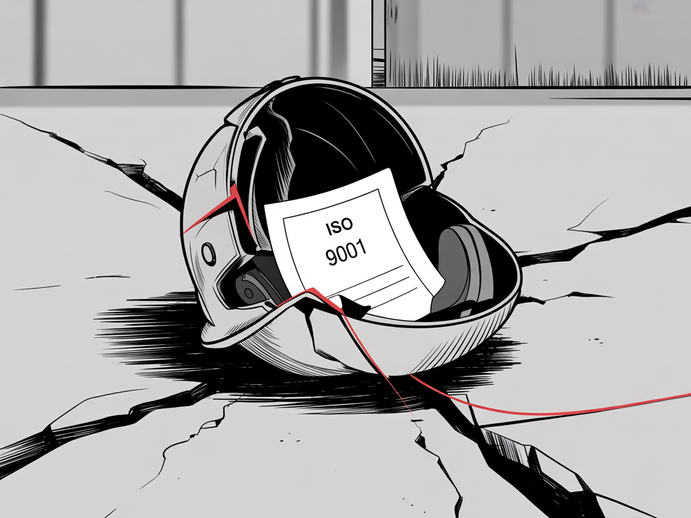
It’s no different from buying the cheapest helmet. It looks fine, it saves a few rupees, but the real cost shows up only in the crash.
And for MSMEs, the crash doesn’t look like blood on the road. It looks like rework silently eating margins, a customer saying “no more orders,” or a team so tired of firefighting that they stop believing improvement is even possible.
That’s the false economy of certificate-only ISO.
The Alternative – Investment, Not Expense
So what’s the other path?
It’s seeing ISO not as an expense but as an investment.
Real ISO isn’t about impressing auditors. It’s about building a living system that works even when no auditor is watching.
Because a living system reduces waste. Scrap goes down, rework reduces, machines running longer without surprise breakdowns. That’s money saved, month after month.
Employees start using the system. Not filling forms for auditors, but using checklists to catch problems early, using procedures to make work easier. Productivity rises, firefighting falls.
Employees know exactly what to do when something goes wrong and more importantly, why they’re doing it.
It’s about scrap reducing month after month. Machines running longer without surprise breakdowns.
Customers notice. They don’t care about your certificate on the wall, but they do care when your deliveries arrive on time, when rejections stop, when your consistency improves. That’s how you win repeat business.
Yes, real consulting feels expensive at first. It takes time to train people, to redesign processes, to build discipline. But every rupee invested comes back multiple times in savings, trust, and growth.
That’s the real ISO, the part certificate-only consulting never tells you.
The Real Cost
So here’s the bottom line.
The real cost of certificate-only ISO isn’t written in the consultant’s bill.
- It’s in the wasted hours of staff who see no meaning in their work.
- It’s in the morale lost when people realize the “system” is a sham.
- It’s in the opportunities missed,
- the scrap that could have been saved.
- the customer that could have been retained.
- the growth that never came.
By the time an MSME realizes this, the damage is already done.
And that proud ₹2,000 certificate or even that lakhs of rupees manual looks like the most expensive piece of paper the company ever bought.
Closing Reflection
The next time someone tells you they got ISO in 30 days, don’t be impressed.
- Ask them if their firefighting stopped.
- Ask them if complaints are reduced
- Ask them if employees feel proud to use the system.
Because if the answer is no, then what they bought wasn’t ISO. It was an illusion.
The difference between paperwork and real systems is night and day. And in the weeks ahead, I’ll show you that contrast through two MSMEs, one that treated ISO as audit survival, and another that made it part of daily life. The outcomes couldn’t be more different.
Until then, here’s the question I leave you with:
👉 Are you saving money on ISO, or are you unknowingly paying for the illusion?
Want to know if your ISO is giving you real returns or just paperwork? Let’s talk. A 30-minute clarity call may reveal costs you didn’t even know you were carrying.