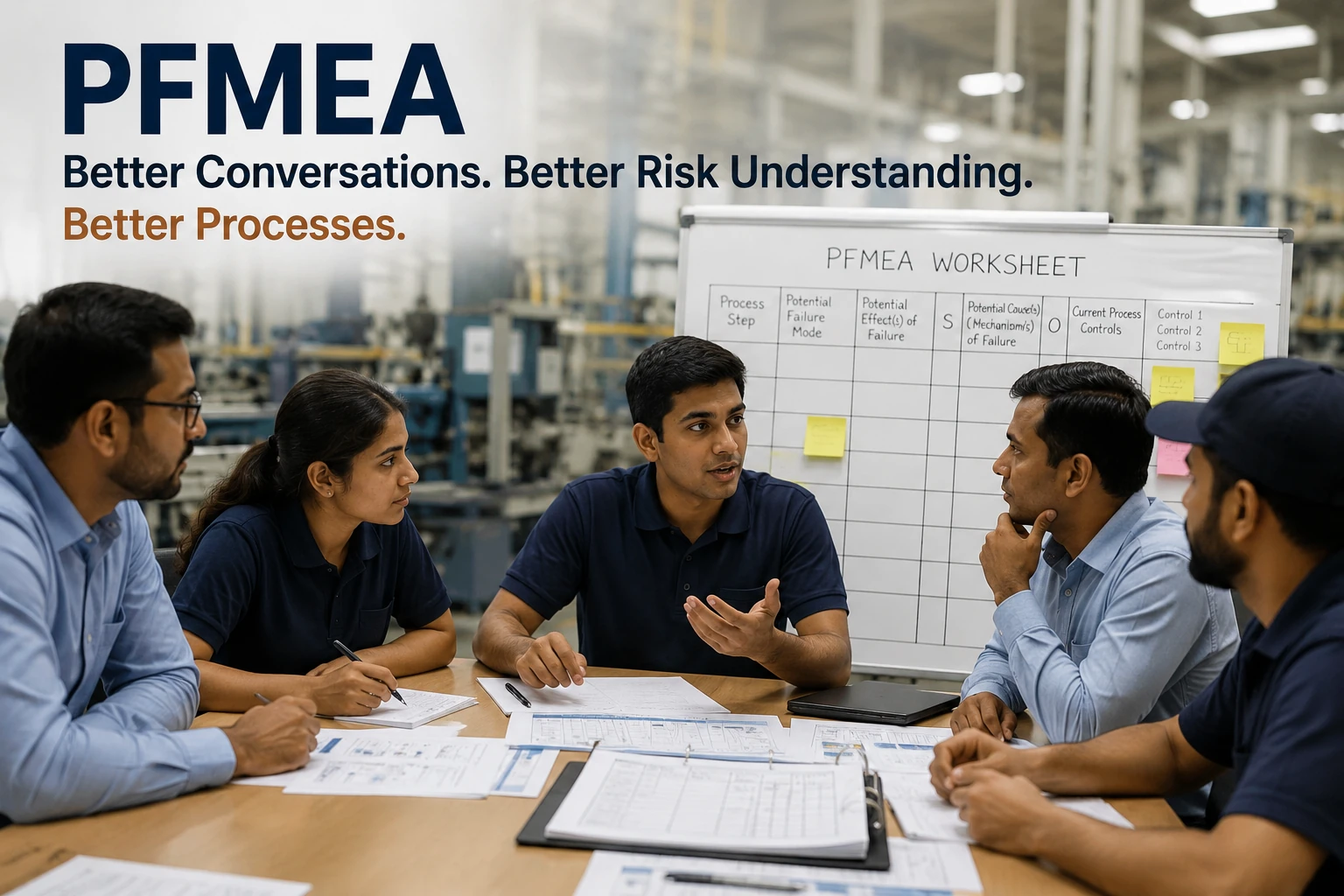
A few weeks ago, while delivering a PFMEA training programme at a Tier-1 automotive company, I witnessed something that made me rethink an assumption I had unknowingly carried for years.
The participants came from different functions and experience levels. Along with engineers and supervisors, the company had also encouraged freshers and shop-floor personnel to attend the programme. I genuinely appreciated that decision because it isn’t something I see very often. In many organisations, PFMEA discussions are usually limited to engineers, quality professionals, and a handful of subject matter experts.
As the training progressed, I noticed a familiar pattern. While the experienced participants actively discussed failure modes and controls, some of the freshers remained quiet. They were attentive, took notes, and followed every discussion, but they rarely contributed. It wasn’t because they lacked interest or capability. Like many people attending a technical workshop for the first time, they simply weren’t confident enough to speak.
Rather than moving on with the next exercise, I walked over to a few of them and spent some time revisiting the concept. Instead of discussing theory again, I asked them to think about just one process they were already familiar with and build a PFMEA around it. My expectation was simple, I wanted them to become comfortable with the methodology before participating in the larger discussion.
I didn’t expect that decision to become the most valuable part of the entire training programme.
When the Training Became a Process Review
Within a short time, the discussion began to change.
The participants who had remained silent until then started asking questions that immediately caught everyone’s attention. They pointed out inspection activities that seemed to exist simply because they had always existed. They questioned whether some inspections actually prevented failures or merely confirmed what was already known. More importantly, they identified a some characteristic that wasn’t being validated within the manufacturing process. If that characteristic failed, the problem would most likely be discovered only after the product reached the customer.
The room became noticeably different. We were no longer discussing how to complete a PFMEA worksheet. We were discussing the process itself.
I want to be clear about what this was and what it wasn’t. It was a training session, not a process review. Nobody raised a corrective action, and I have no idea whether that characteristic is being validated today. What happened in that room was a group of people looking at their own process honestly for an hour and that is exactly what the exercise is supposed to produce.
The worksheet had quietly become a catalyst for a much more meaningful conversation. That moment stayed with me long after the training had ended, because it challenged something I had rarely questioned before.
Different People See Different Risks
It would be easy to conclude that the freshers had discovered something the experienced engineers had missed. But that isn’t what happened. As I reflected on that session, I realised something I had overlooked for years. The engineers and the operators weren’t looking at the same process through different levels of expertise. They were looking at two different versions of the same process.
One version existed in drawings, specifications, control plans and documented work instructions. It described how the process was designed to behave, what the customer required, and what the organisation had committed to deliver.
The other existed on the shop floor in small adjustments, repeated observations, temporary workarounds and countless decisions that operators make every day without consciously thinking about them. It described how the process actually behaved on a Tuesday afternoon, on the second shift, when the material was slightly different from last week’s lot.
Neither version was wrong. In fact, both were necessary.
A process cannot be understood completely from documentation alone, just as it cannot be understood completely from experience alone. The first version tells you what should happen. The second tells you what does happen.
Risk usually lives in the gap between what the process is designed to do and what it actually does. That gap is invisible to anyone who only sees one version of the process.
The engineers knew where the process could fail in principle. The operators knew where it hesitated in practice. Until that morning, those two bodies of knowledge had never been placed on the same table.
Neither group could have produced the same outcome on its own. If the exercise had involved only engineers, the discussion would probably have remained technically correct but incomplete. If it had involved only operators, practical concerns would have emerged, but without the context of customer requirements and design intent. The value came from bringing both perspectives together. It wasn’t expertise that made the difference. It was the combination of expertise and experience.
Manufacturing processes don’t exist on paper. They exist on the shop floor, where people, machines, materials and methods interact every minute of every shift. Any risk assessment that ignores one of those perspectives is working with an incomplete picture.
Experience Can Sometimes Hide Opportunities
One part of the experience fascinated me even more. The questions coming from the freshers weren’t complicated. In fact, they were remarkably simple.
- “Why are we inspecting this?”
- “If this characteristic is important, why aren’t we checking it earlier?”
- “What failure is this inspection actually preventing?”
Simple questions often create uncomfortable silence, because they challenge assumptions that have quietly become part of everyday work.
That doesn’t mean experienced people become less effective. Quite the opposite. Experience allows us to recognise patterns, solve problems faster and make better decisions under pressure, because we’ve seen similar situations before.
But the same experience can also make certain practices feel so normal that we stop asking why they exist. Controls become routine. Inspections become habits. Workarounds become accepted practices.
The fresher doesn’t have that advantage, They also don’t have that limitation.
One Question I’ll Continue Asking
Looking back, the worksheet itself had very little to do with what made that session valuable. We hadn’t discovered anything because we had followed the AIAG methodology perfectly. We discovered it because the right people were finally having the same conversation. The worksheet simply gave that conversation a structure.
And the biggest opportunity that day wasn’t hidden in the worksheet. It was hidden in the people who hadn’t been speaking for the first half of the session.
When I walked into that training room, I thought I was there to teach PFMEA. I walked out with a different lesson. Good PFMEAs aren’t created because one person understands the methodology better than everyone else. They become better because the conversation includes people who see the process differently.
Before your next PFMEA meeting, don’t begin by opening the worksheet, begin by looking around the room.
Ask yourself a simple question.
Who isn’t here?
The answer may tell you more about the quality of your PFMEA than the worksheet ever will.