

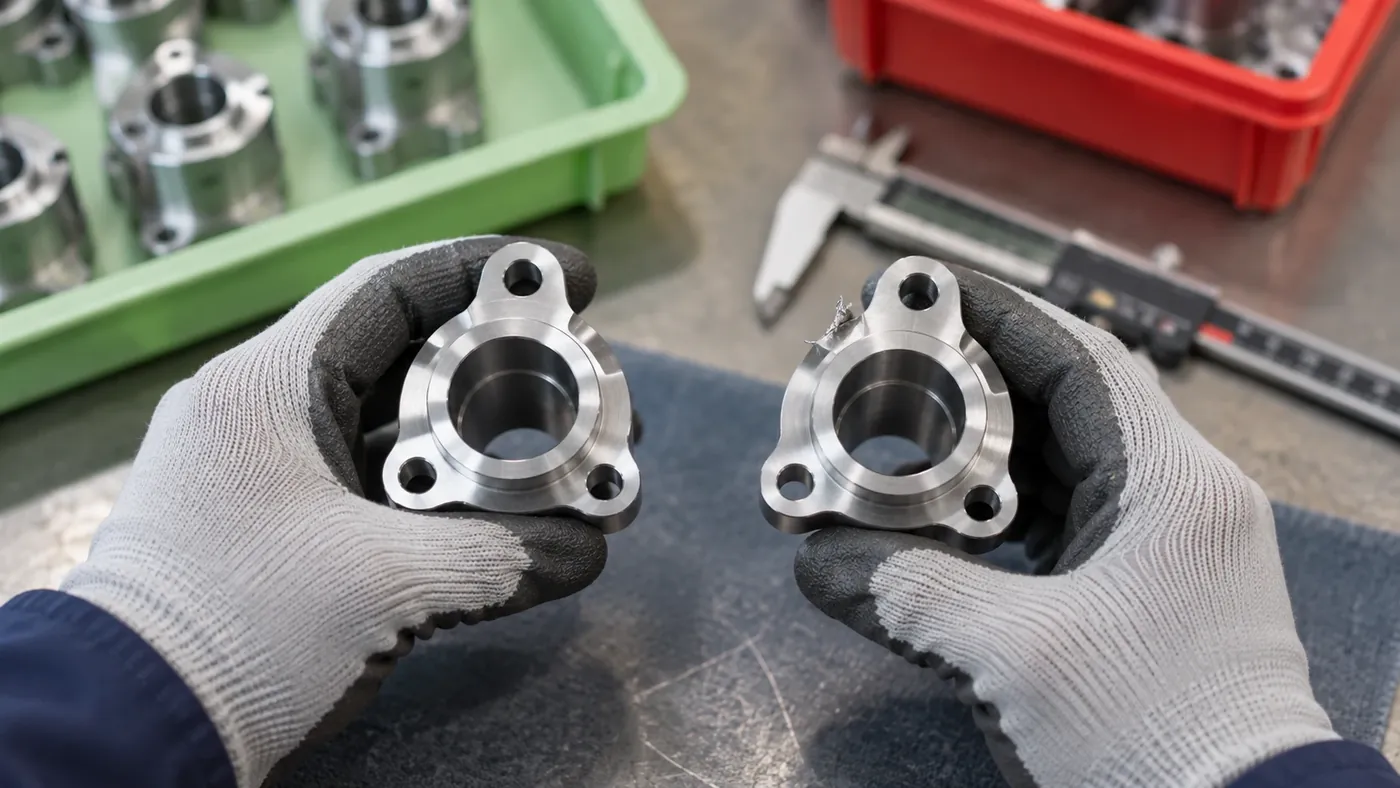
A burr is found on a machined part during the night shift. The operator tells the supervisor, the supervisor writes it in the shift register, and the parts go into a red bin. Three days later the problem comes up in the weekly quality meeting. By then the red bin has been cleared, the operator is on another shift, and the setting that caused the burr has been changed twice. Everyone gives an opinion. Nobody has the part.
QRQC exists to stop exactly this. It is a simple daily routine that makes the team react to a quality problem while the part, the people and the evidence are still there.
What does QRQC mean?
QRQC stands for Quick Response Quality Control. It is not a form or a software. It is a way of working with three ideas behind it:
- Go and see. Problems are discussed at the place where they happened, with the real part in hand and real data, not in a meeting room from memory.
- React fast. The customer is protected within the shift or the day, not after the analysis is finished.
- Think it through. The cause is proved with facts before the action is chosen, so the same problem does not come back.
Many automotive customers expect their suppliers to run QRQC, and some have their own formats. IATF 16949 does not use the word QRQC, but its problem-solving clause (10.2.3) asks for the same things: contain, find the root cause, act, and check that the action worked. QRQC is the daily habit that makes this happen on the line.
The 24-hour loop
The heart of QRQC is a short loop that starts the moment a defect is found. The exact timing depends on your plant and your customer, but a common rhythm looks like this:
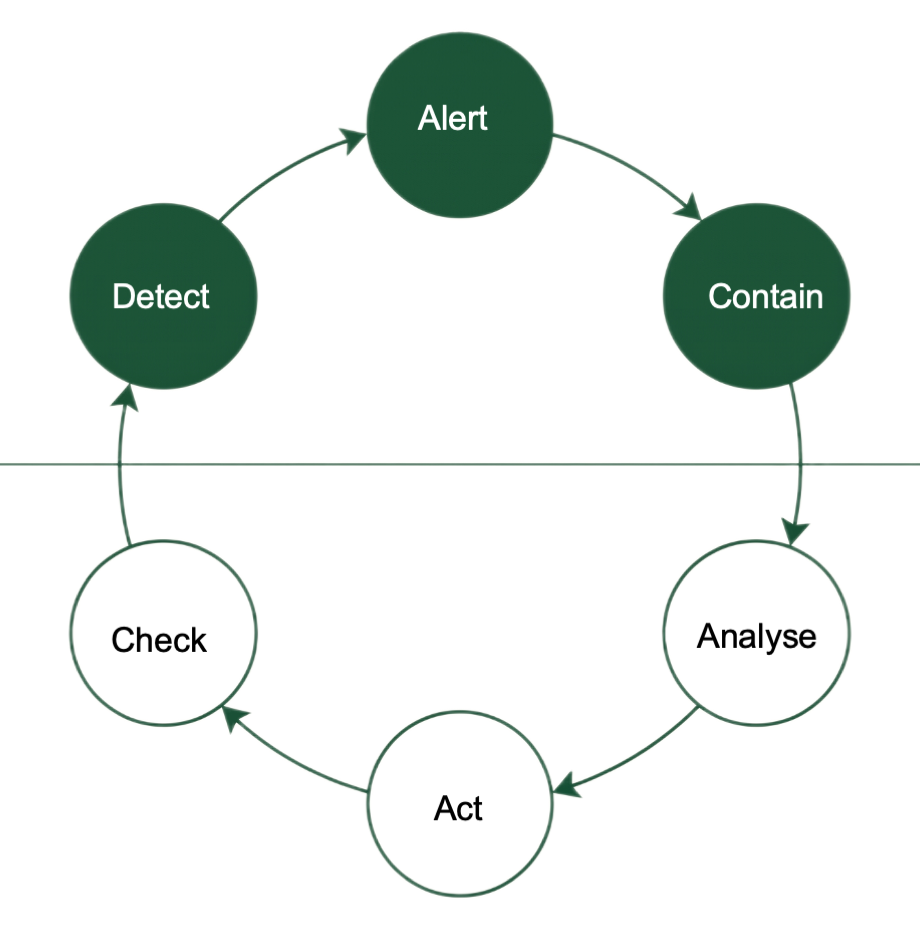
| Step | What happens | When |
|---|---|---|
| Detect | Someone finds a bad part or a process that is out of its limits | Any time |
| Alert | The team leader is told at once, and the problem goes on the QRQC board | Within the hour |
| Contain | Suspect parts are stopped and sorted: at the machine, in stock, in transit, at the customer | Within the shift, at most 24 hours |
| Analyse | At the line, with the part: what is different from a good part, what changed, why | Next QRQC meeting |
| Act | A countermeasure is agreed, with one owner and a date | Usually within a few days |
| Check | Someone confirms the action worked, with data, before the problem is closed | After the action, over enough parts to be sure |
The first three steps are about protecting the customer. The last three are about making sure it does not happen again. Many plants are good at the first half and weak at the second, which is why the same problems keep returning to the board.
The QRQC meeting
The QRQC meeting is short, daily, and held standing at the board near the line. It is not the weekly quality review.
- Where: at the QRQC board, close to the process, with the defective part on the table.
- When: the same time every day, usually at the start of the first shift, so the night shift's problems are still fresh.
- How long: about 10 to 15 minutes at line level.
- Who: the team leader or supervisor, the quality engineer, the process or production engineer, and maintenance when a machine is involved. The operator who found the problem adds more than anyone else.
The meeting answers three questions, in this order:
- What went wrong in the last 24 hours? Each new problem is described in facts: what part, what defect, how many, on which machine, which shift.
- Is the customer protected? For each problem, is containment done, and where are the suspect parts?
- Where are the open problems? Owners give a one-line status on actions due. Anything stuck is escalated, not discussed at length.
Detailed analysis does not happen in the meeting. The meeting decides who goes and does it, with whom, by when.
QRQC levels
Larger plants usually run QRQC at more than one level:
- Line QRQC every day, for problems found on that line.
- Plant QRQC every day, a little later, for problems the line could not solve alone or that affect several lines.
- Customer QRQC for complaints and problems that have reached the customer, often with the customer's own format and timelines.
Clear escalation rules decide what moves up: for example, a problem not contained within the shift, a repeat within 30 days, or any defect found by the customer.
The QRQC board
The board is where the loop is made visible. A whiteboard or a printed sheet is enough. What matters is that anyone walking past can read it, and that it is updated every day, not before audits.
A simple QRQC board has one row per problem with these columns:
| Column | What to write |
|---|---|
| Date and shift | When the problem was found |
| Problem | Part, defect, quantity, machine, in plain words |
| Containment | What was done to protect the customer, and where suspect parts are |
| Cause | The proved cause, or "not yet known" |
| Action | The countermeasure, one line |
| Owner and date | One name, one date |
| Check | How the result was confirmed, and when |
| Status | Open, action done, closed after check |
Some plants add a simple coloured mark for each day a problem stays open. After a week of red marks, nobody needs to ask which problem is stuck.
Where QRQC goes wrong
Most plants that "have QRQC" have a board and a meeting. Fewer have a working routine. The signs are easy to spot:
- The meeting moved to a conference room. No part, no line, and the discussion is about reports instead of the problem.
- The board is filled in before the meeting, by one person, from the register. The team reads it out instead of looking at the problem.
- "Operator error" is the cause and "retrain operator" is the action. This is almost never the real cause.
- Problems are closed when the action is done, not when someone has checked that it worked.
- The same problem appears again under a new date, and nobody links it to the earlier one.
- No escalation rule, so a problem sits at line level for two weeks before the plant manager hears about it.
When any of these show up, the answer is rarely a new format. It is getting the meeting back to the line, keeping it short, and making sure each row has a real owner and a real check.
When QRQC is not enough
QRQC is built for speed. Some problems need more time and a wider team: customer complaints, problems whose cause is not found within a few days, or problems that come back after an action. These move from the QRQC board into an 8D or an A3, and the board keeps a line pointing to it until it is closed.
Inside QRQC, simple tools do most of the work: a check sheet to collect the right data, a Pareto chart to see which defects matter most, a 5 Why at the line with the part in hand. Our article on using the 7QC tools in sequence shows how these fit together, with a free Excel template.
Getting QRQC to run every day
Starting QRQC is easy. Keeping it alive after the first month is the hard part, especially when production pressure is high. If your team would like to set up QRQC on your lines, or bring an existing routine back to the floor, let's talk about QRQC implementation for your plant. For teams who want the methods first, our problem-solving training covers QRQC, 5 Why, 8D and A3 with your own examples.