
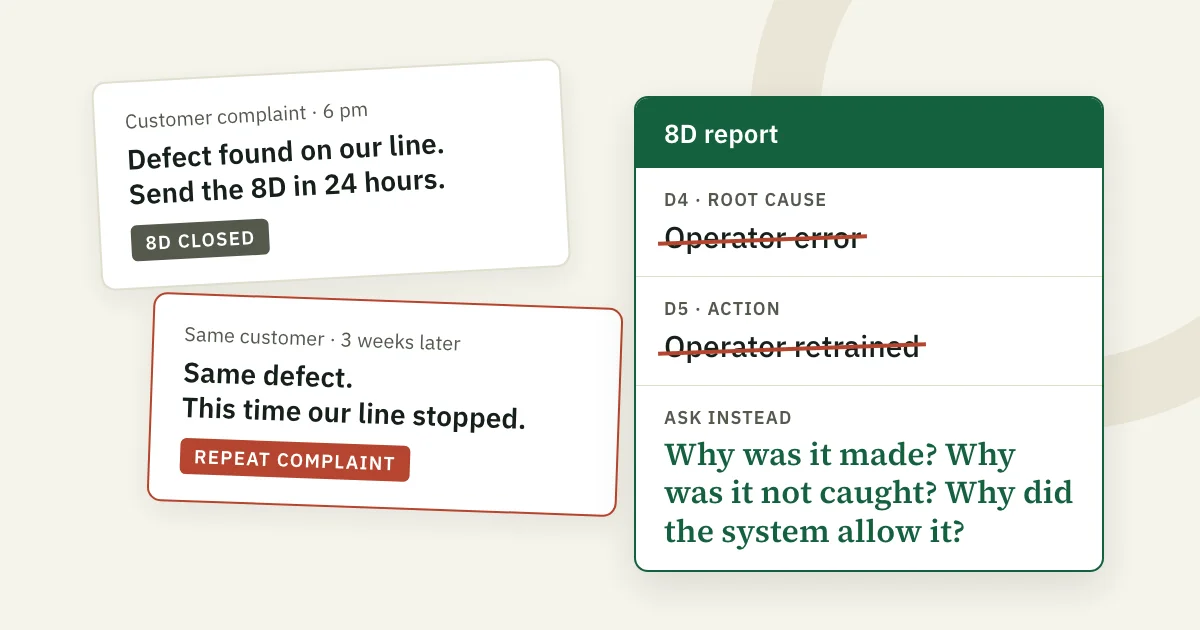
It is 6 pm and a mail arrives from the customer: defect found on their line, send the 8D within 24 hours. The team opens last month's 8D and saves it under a new name. A quick why-why in the meeting room. "Root cause: operator. Action: operator retrained." Sent. Closed.
Three weeks later the same mail comes back. Same defect. This time their line stopped.
This is an example, but anyone who has worked in automotive quality will know it. The team was not careless. The 8D was written to close the complaint, not to solve the problem. This article looks at the three shortcuts behind most repeat complaints, what to write instead of "operator error", and the parts of an 8D that are most often missing.
The real problem is the clock
Most shortcuts come from one thing: trying to finish the whole 8D in the first 24 hours. Only containment fits in a day. Finding the cause, proving it and fixing it takes days, sometimes weeks. Squeeze all of it into day one and the shortcuts are guaranteed.
Split the response instead:
- Within 24 hours: containment. The customer is protected and every suspect part is found.
- A dated plan for the rest: when the root cause will be confirmed, and when the permanent action will be in place.
Think of a wet floor and a running tap. Containment is the mop, and you need it today. The root cause is the tap. Most quick 8Ds just buy a better mop.
Shortcut 1: containing only what you can see
After a complaint, the team sorts every part inside the plant. Stores, line, finished goods: all checked. But where were the bad parts? In the truck. In the customer's store. On the customer's line. Some in rework, some in spares.
Before you close containment, ask one question: where else can the suspect parts be? Then:
- Tag every suspect crate so anyone can read its status at a glance.
- Tell the customer the clean point: the first lot made after the fix, so they know which parts they can trust.
Shortcut 2: guessing in the meeting room
A why-why done from memory produces guesses, not causes. Take a burr on a drilled hole. In the meeting room, the team writes "operator did not check" and "material variation". At the machine, the drill bit is worn, and nobody tracks tool life.
Go and see before the first why: the real part, the real machine, the people who run it. Then test the chain. Read it from the bottom up and join each step with "therefore". "Drill bit worn, therefore burr" holds. "Operator not trained, therefore burr" does not. If a link breaks when you say it aloud, it is not proved.
Shortcut 3: stopping at "operator error"
"Operator error" feels like a cause because a person was involved. It is almost never the end of the chain. People make mistakes in every plant, on every shift. The real questions are why the process let the mistake happen, and why nobody caught it.
There is also a cost that never shows in the 8D. The operator reads "Root cause: me". The next time something feels wrong, they keep quiet. Blame does not fix the problem. It hides the next one.
What to write instead
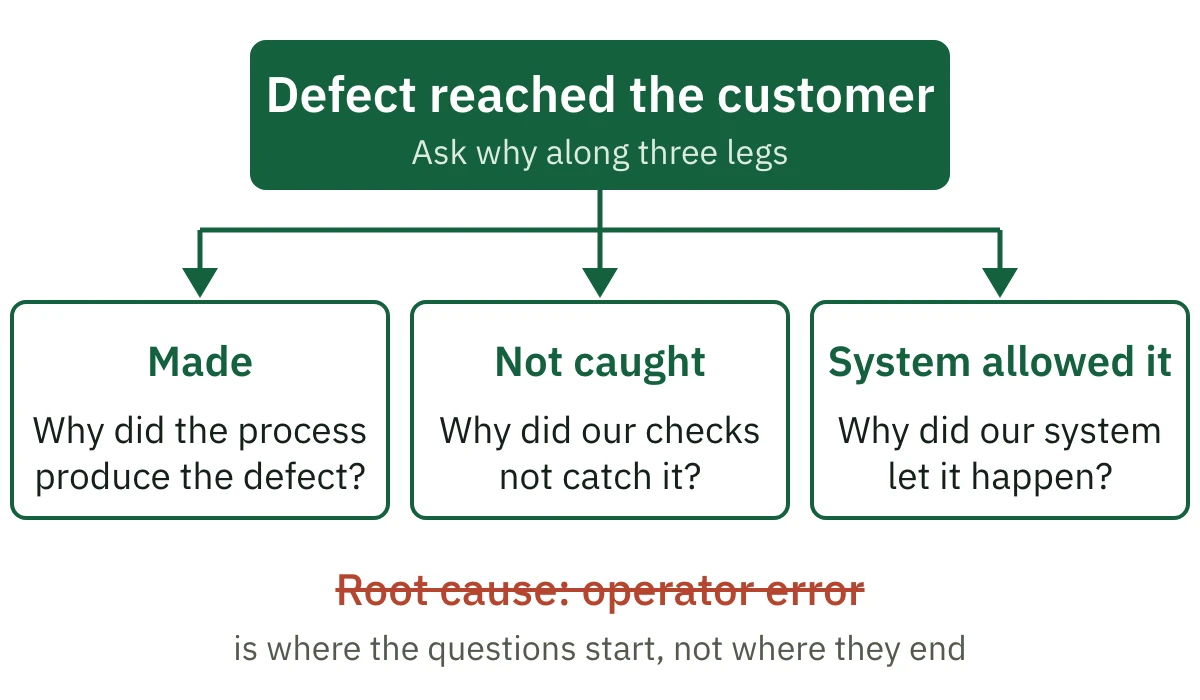
Ask why along three separate legs. Each leg gets its own answer and its own action.
| Leg | Question | Example answer (the burr) |
|---|---|---|
| Made | Why did the process produce the defect? | Drill bit used past its life; no tool life counter |
| Not caught | Why did our checks not catch it? | Burr check is visual, once a shift; a small burr is hard to see under oil |
| System allowed it | Why did our system let it happen? | Tool life is not in the control plan; the PFMEA rated detection as good |
The 5-second test
Read each action aloud. If it is talking to someone (retrain, create awareness, tell them to be careful), the tap is still running. If it changes the machine, the method or the check, you are close. Then ask: where else can this happen?
What most 8Ds miss
Teams that avoid the three shortcuts still often skip three things.
The escape point. Every defect that reaches the customer has two causes: why it was made, and why it got out. Find the point in your process where it should have been stopped. Was there a check for it at all? Was the check able to see this defect? Was it done at the right frequency? Fix the check, not only the cause.
Proof that the fix worked. An action marked "done" is not a problem solved. Look at the result after the change, with data, over enough parts and enough time to be sure: the defect count, the measurement, the customer's incoming results. Close the 8D only then.
Read-across. The same worn tool can be on the next machine, the sister part, the other shift. Ask where else the same cause can act, and act there too. Then update the PFMEA and the control plan, so the lesson stays in the system and the next team does not have to learn it again. Our article on PFMEA and process knowledge shows why the people on the floor matter here.
Five checks before you close an 8D
- Containment covered every place the parts could be, and the customer knows the clean point.
- The cause was seen at the machine, and the chain holds when read with "therefore".
- All three legs are answered: made, not caught, system allowed it.
- Every action changes the machine, the method or the check, and has been read across to similar processes.
- The fix is proved with data after the change, and the PFMEA and control plan are updated.
If any check fails, the 8D is not ready to close, whatever the deadline.
When the same complaints keep coming back
Repeat complaints are rarely about one bad 8D. They usually point to how the team works under pressure. If you would like your team to practise this on real examples, our problem-solving training covers 8D, 5 Why, A3 and QRQC. For problems that need to be fixed fast, the QRQC article shows the daily routine that catches defects before they reach the customer.